California agencies eye BurnBot for wildfire prevention

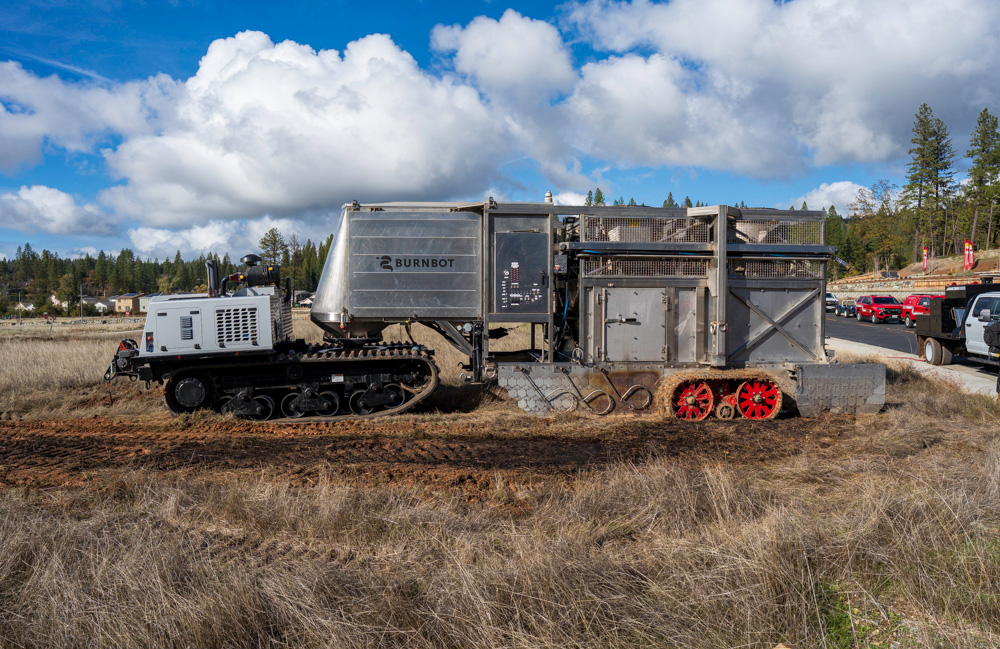
The BurnBot RX 2 robot is designed to incinerate the ground with temperatures up to 1700°F. | Credit: The Robot Report
Participants from various agencies toured three sites this week in Nevada County, California to see demos of BurnBot. The goal was to assess how BurnBot could be used by local jurisdictions to help prevent wildfires. Members of the American Forest Foundation (AFF), BurnBot, and Pacific Gas and Electric Company (PG&E) were in attendance.
Wildfires have been devastating California for years. In fact, PG&E equipment has been a significant cause of major wildfires in California on multiple occasions. Experts are exploring how tools like BurnBot could help reduce that destruction by making prescribed burns safer, more efficient, and easier to carry out.
The primary advantages of using BurnBot over traditional blading methods center on ecological sensitivity and cost-efficiency. Ecologically, BurnBot maintains vital soil structure and supports native species restoration by mimicking natural fire cycles, the company said. This avoids the encouragement of invasive species often seen with using bulldozers or graders to scrape the ground.
BurnBot also said its technology is a more cost-effective and efficient solution for large-scale land management. The company said its allows for the precise, controlled burning of segmented areas under optimal conditions, a process that helps maintain the crucial ecological balance better than mechanical clearing.
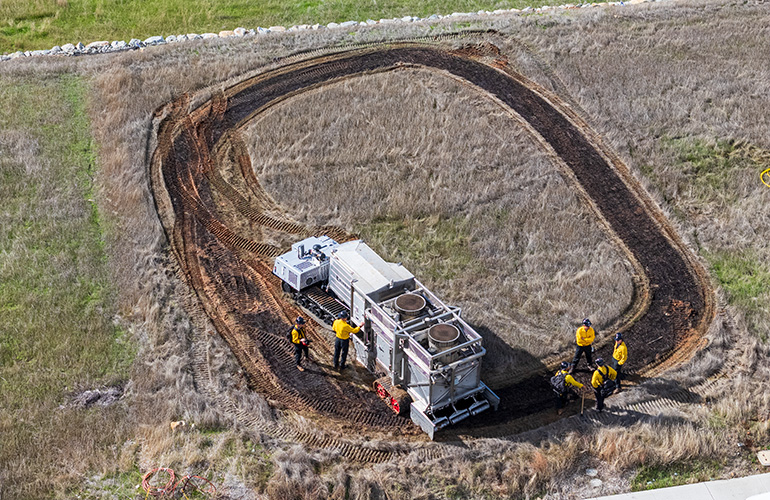
BurnBot operates like a Zamboni, leaving a burn scar for framing the region for a prescribed burn. | Credit: The Robot Report
How BurnBot works: a fully integrated burn system
BurnBot is engineered to safely, cleanly, and efficiently lay down black lines, which serve as a boundary for prescribed burns. This enables the burn boss and crew to contain a fire within a defined area.
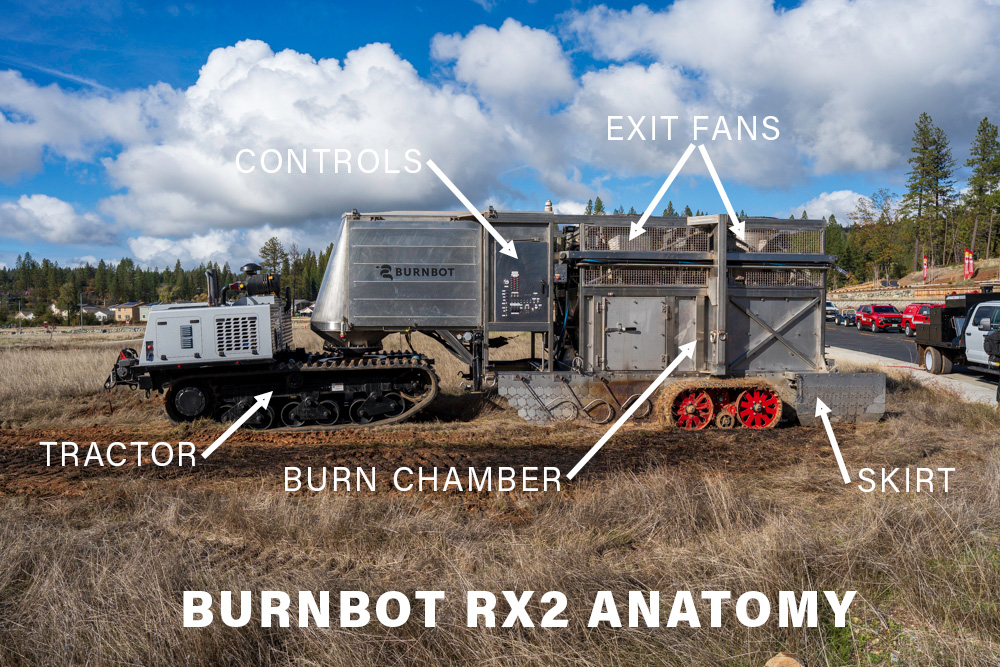
Anatomy of the BurnBot RX2. | Credit: The Robot Report
Currently, the BurnBot RX2 is remotely controlled by an operator on site within 500 feet of the vehicle. Operators are typically ex-firefighters who have been trained in fire safety and who understand the environmental conditions for safe operations, as well as how to assess and control the post-burn area.
“We are working towards an autonomous future, potentially even a swarm scenario once we get mass adoption and also the use cases to justify that,” BurnBot’s Josh Wilkins told The Robot Report.
The best practice for operating BurnBot is to use it much like a Zamboni. It lays down a pre-burned path that defines the boundary of a prescribed burn area. The operator controls the tractor’s direction and speed, then sets burn parameters that determine the height and temperature of the propane torches inside the burn chamber trailing behind the tractor.
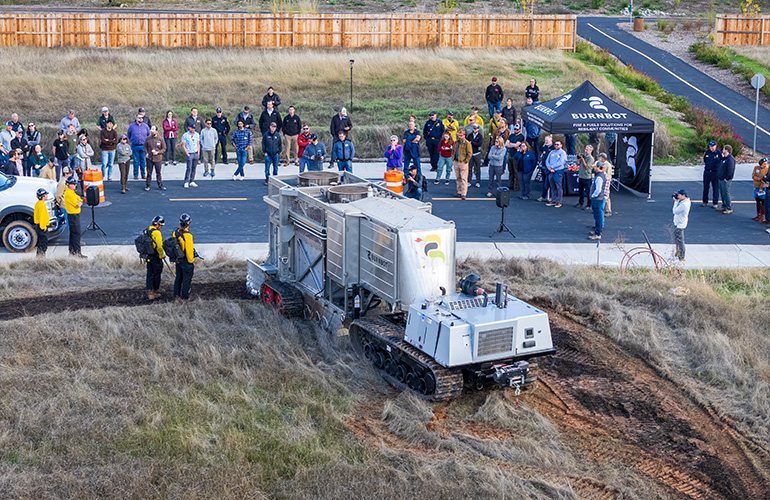
The crowd watching the BurnBot demo in Grass Valley, Calif. | Credit: The Robot Repot
Large fans mounted over the burn chamber draw in oxygen through the side skirt to feed the fire and vent heated air out the top. Steel rollers at the rear of the chamber press against the ground to tamp out embers, while a light water spray dampens the surface to extinguish anything that remains.
The machines are built for 24/7 operation in most weather conditions. BurnBot can travel up to 20 MPH and can burn across a wide range of terrain, even on slopes as steep as 58%.
Ultimately, BurnBot automates and optimizes vegetation management and prescribed burning to create defensible spaces and reduce the fuel load that drives wildfires. Its work is supported by a data platform that provides real-time mapping, tracking, and analysis to plan smarter treatments. BurnBot believes this higher-resolution data will help fire management agencies better prepare for wildfire season and more effectively manage the landscape.
Deploying BurnBot in Nevada County
Nevada County sits in the Sierra Nevada foothills, halfway between Sacramento and Lake Tahoe. Known historically for its gold mines and well-preserved Gold Rush heritage, the area is now a destination for world-class hiking, mountain biking, and kayaking. But that natural beauty also comes with extreme wildfire risk.
“We have open, grass-filled acreage where this [machine] is very appropriate,” Duane Strawser, OES Director for the City of Grass Valley, told The Robot Report. “And what I see is that all the science – arborist reports, biological reports, landscape reports – shows that burning the soil is definitely a healthier method of framing a fuel break or fire break. And that treatment, in most cases, leads to fewer invasive plant species returning quickly.”
“[BurnBot] is easier and more affordable for large property owners, whether private or municipal, to prep a property for a very efficient open burn and cover a lot more acreage that way, versus the cost and expense of bringing in heavy machinery to frame in [the prescribed burn], which is what CAL FIRE requires for burn permits,” Strawser added.
Grass Valley expects to deploy BurnBot in the coming year on acreage with wider, more open, and flatter terrain. For steeper areas, the city will continue to rely on hand crews and mechanical blading where needed. Strawser has worked with BurnBot for several years, helping provide in-field testing opportunities as the company has refined the product.