Driving Hai Robotics’ U.S. expansion

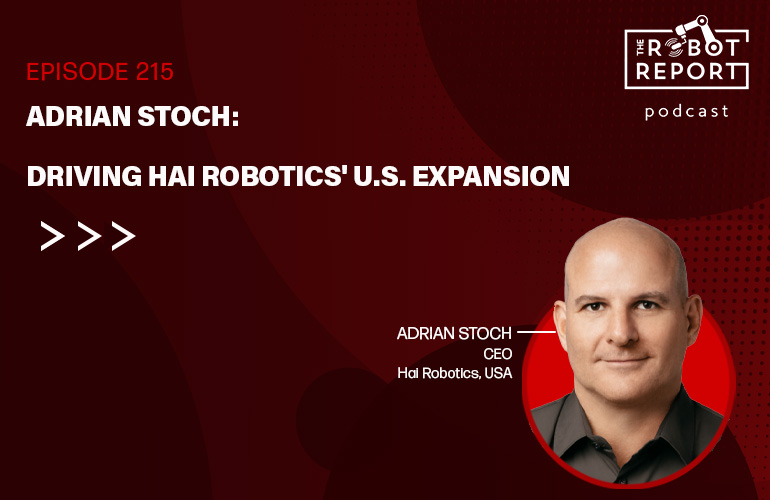
In Episode 215 of The Robot Report Podcast, hosts Steve Crowe and Mike Oitzman recap the major robotics news of the week.
Adrian Stoch, CEO, Hai Robotics USA
Also on the show this week is Adrian Stoch, CEO of Hai Robotics USA. He discusses his transition from GXO Logistics to a leadership role at Hai Robotics, driven by the company‘s customer-centric approach and innovative culture led by founder Richie Chen.
Stoch also talks with editors Oitzman and Eugene Demaitre about the importance of aligning automation solutions with customer needs. He notes the shift towards large-scale automation in response to global supply chain challenges and labor constraints.
In addition, Stoch outlines his goals for Hai Robotics in the Americas, focusing on building a talented team and implementing lean processes to support growth and customer success.
Show timeline
05:18 – News of the week
25:24 – Conversation with Adrian Stoch, CEO Hai Robotics, USA
News of the week
Dexory claims 500M scan milestone and closes $80M in funding
Dexory announced that its autonomous robots have scanned 500 million warehouse locations.
The company claimed that its technology is capable of capturing and processing this scale of data in real time. Every single scan strengthens the system, powering even greater accuracy and impact for our customers.
Dexory this week closed an $80 million Series B funding round. The company said the funding will support an expansion of its AI-powered features across its DexoryView platform.
With the close of the round, Dexory has now raised $120 million over the past three years. Since the company launched its autonomous warehouse robots and software platform for the logistics sector only 18 months ago, it has reported strong growth.
The Dexory also plans to grow its global team and accelerate the deployment of its autonomous robots. The company will continue focusing on expanding across the U.S. market, where it already has customers in seven states. Finally, Dexory plans to use the Series B funding to enhance development and production facilities at its U.K. headquarters.
DoorDash unveils Dot, its first commercial autonomous delivery robot
DoorDash unveiled Dot, its first autonomous delivery robot built to travel on bike lanes, roads, sidewalks, and driveways. At one-tenth the size of a car, DoorDash designed Dot for quick deliveries.
The robot can travel up to 20 mph (32.1 kph), making it suitable for neighborhood trips to help local businesses meet growing consumer demand. The San Francisco-based company said the electric robot is small enough to reduce congestion and agile enough for smooth handoffs.
Dot can fit up to six large pizza boxes and carry up to 30 lb. (13.6 kg) of cargo. At 4 ft. 6 in. (137.1 cm) tall, DoorDash claimed that Dot is visible to road users but small enough to fit through most doors.
Zoox tests self-driving service in Washington, D.C.
Zoox Inc. has launched test vehicles in Washington, D.C., initiating the process to eventually deploy its driverless robotaxi service. It is the eighth city for Zoox and its first location in the mid-Atlantic.
The company‘s test fleet is currently operating in seven other cities, including the San Francisco Bay Area, Las Vegas, Seattle, Austin, Miami, Los Angeles, and Atlanta. Zoox recently launched its service in Las Vegas, which it said makes it the first company to provide a fully driverless ride-hailing service in a purpose-built robotaxi in the city.
In Washington, D.C., the first step is to manually map the operating area within the geofence. The sensor-equipped passenger vehicles typically include a couple of engineers onboard as the test vehicle is driven on every surface street and parking lot with the operating area.
Data gathered from the mapping process is processed and consolidated to create a working map based on the sensor package standard for Zoox robotaxis.
Waymo extends NY permit
New York City regulators have extended Waymo’s autonomous vehicle (AV) testing permit through the end of 2025.
The permit was initially granted in August to allow Waymo to test its robotaxis in the city until the end of September. The terms of the extended permit are the same: Waymo can deploy up to eight of its Jaguar I-Pace vehicles in Manhattan and downtown Brooklyn with a human safety operator behind the wheel.
A spokesperson for Waymo said the permit makes the company’s drivers exempt from New York’s rules mandating that drivers must keep one hand on the wheel at all times.
Still, Waymo has a long way to go in New York — a city where the Alphabet-owned company has been trying to operate since 2021. Even with this permit, Waymo cannot carry passengers or operate a commercial robotaxi service without getting separate licenses from the city’s Taxi and Limousine Commission.
Another hurdle is that there is no permitting structure in New York that allows Waymo or any other AV company to test or deploy robotaxis without a human safety driver.
Waymo makes an illegal U-turn
Police in a Silicon Valley suburb were flummoxed last weekend after pulling over a self-driving Waymo robotaxi for making an illegal turn, then finding no driver, they could issue a ticket.
The incident happened in San Bruno, Calif., where police set up a checkpoint to catch intoxicated drivers. As cars lined up, one vehicle, a self-driving Waymo, pulled an illegal U-turn and began to drive away.
The police fired up their lights, and the Waymo pulled over automatically as the operator trains its cars to do. But the police officers who pursued the robo-taxi couldn’t hand out a ticket, since the driverless taxi had nobody inside.
“Since there was no human driver, a ticket couldn’t be issued — our citation books don’t have a box for ‘robot,’” said the San Bruno Police Department on its Facebook page. “Hopefully, the reprogramming will keep it from making any more illegal moves. It was a first for both officers.”
Human drivers who make illegal turns risk a $234 fine, plus court fees if drivers contest a ticket. San Bruno’s police acknowledgd that they currently lack the authority to bill the vehicle’s operator. However, changes are in progress to make that possible, the force said.
In 2024, Waymo reportedly racked up $65,065 in parking tickets in San Francisco, a tiny fraction of the $120 million worth of tickets issued around the city in that year.
Top 10 robotics developments of September 2025
Don’t miss September recaps on both The Robot Report and Automated Warehouse.
SPONSOR
Are manual picking operations or idle robots slowing your growth?
The cutting-edge Zebra Symmetry Fulfillment solution is engineered to reduce your costs per unit and give you an unbeatable competitive edge.
Autonomous mobile robots guided by Team Intelligence empower your workers to achieve their maximum potential, enabling you to scale efficiently and boost profitability.
Don’t settle for less—maximize your profits with Zebra.
Discover the future of fulfillment at https://www.zebra.com/fulfillment
Catch the latest on humanoid and surgical robotic development at RoboBusiness 2025. Join Deepu Talla, vice president of robotics and edge AI at NVIDIA, for a keynote titled “Physical AI for the New Era of Robotics.”