
Forterra brings in $238M to scale AI platforms for defense applications

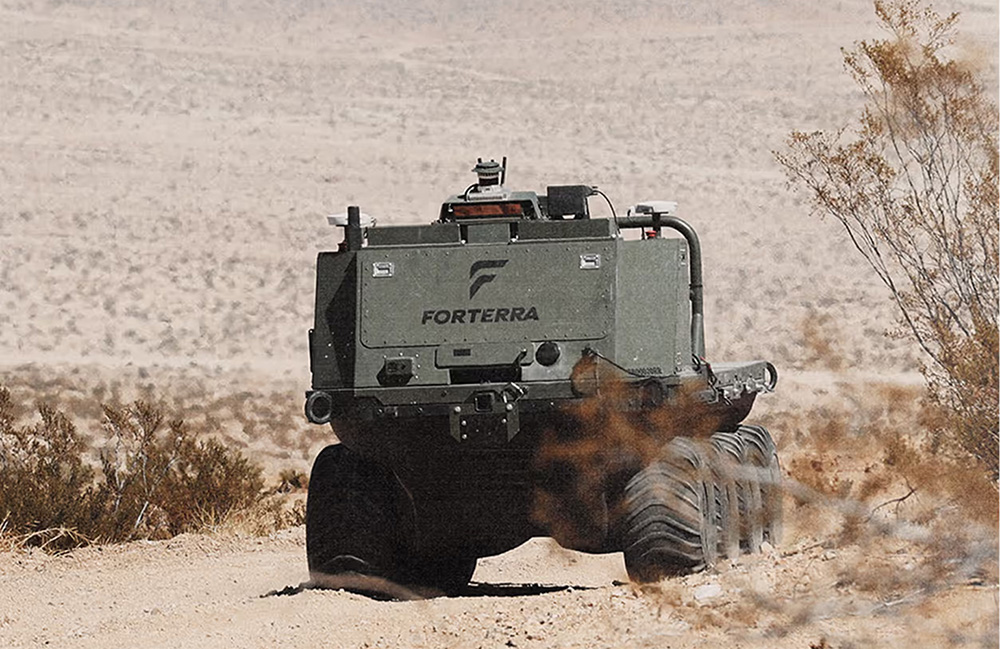
Forterra builds scalable, robust, mission-critical hardware and software for defense and logistics. | Source: Forterra
Investors are putting more money into military robotics. Forterra last week raised $238 million in Series C equity and debt. The company said it plans to use the funds to support continued innovation in communications, command, and control systems. Forterra also plans to enhance production capacity for edge computing platforms serving defense and emerging mission domains.
“Autonomous systems are an operational imperative,” stated Josh Araujo, CEO of Forterra. “This funding propels Forterra’s mission to be the connective tissue of modern operations. Our interoperable mission modules and autonomous stack are already enabling a new generation of platforms to move, sense, and act without limits.”
Forterra provides autonomous operating systems for complex, high-stakes environments. This includes self-driving systems, coordinated swarms of drones, and more. The Clarksburg, Md.-based company claimed that its technology is scalable and robust and can act as “a force multiplier, extending reach, survivability, and effectiveness across the battlespace and industrial applications.”
“As a country, we must focus on prioritizing resilient logistics and adopting technologies that multiply combat, enabling a more capable and agile force to preserve a decisive advantage,” said Forterra. “What’s needed is a new class of cognitive mission systems—autonomous, interoperable, and intelligent platforms.”

Forterra supplies autonomy, communications
Forterra’s product portfolio includes AutoDrive, TerraLink, Vektor, Oasis, and goTenna. AutoDrive is a self-driving system that can work on roads, backcountry, and battlefield terrain.
TerraLink is a modular platform that provides real-time oversight of vehicles, making it easier to track, coordinate, and adapt mission plans.
Founded in 2002 as Robotic Research, the company described Vektor as an edge-deployed, software-defined communication and smart data-brokering layer. It is designed for operations in disrupted, degraded, intermittent, and low-bandwidth (DDIL) environments.
Oasis is Forterra’s end-to-end ontonology platform that enables its products to communicate with third-party software and hardware.
Finally, goTenna delivers lightweight, interoperable mesh networking devices, fixed relay infrastructure, and software for secure, off-grid connectivity for military, law enforcement, and public safety operations, according to Forterra.
“Autonomy is no longer optional; it’s an operational imperative,” it said. “This funding accelerates our mission to be the connective tissue of modern operations. Our autonomous stack and interoperable mission modules are already enabling fleets to move, sense, and act without limits.”
Company builds momentum with contracts
Moore Strategic Ventures led Forterra’s Series C fundraising. The round also included participation from new investors, including Salesforce Ventures, Franklin Templeton, Balyasny Asset Management, 645 Ventures, Hanwha Asset Management, 9Yards Capital, and NightDragon, alongside existing investors XYZ Venture Capital, Hedosophia, and Enlightenment Capital.
Doubling down on their investment in Forterra, Crescent Cove provided both equity and debt, showing continued support since the company’s Series A in 2021. The company’s valuation is now at $1 billion, according to Bloomberg.
This round of funding comes on the heels of a string of contract wins for Forterra, including:
The first ground autonomy production contract with the U.S. Marine Corps for the ROGUE Fires uncrewed vehicle
A $114 million prime contract to deploy autonomous breaching systems for the U.S. Army
Phase II Small Business Innovation Research (SBIR) for the Army’s GEARS palletized load system program
A $4.8 million contract for the Army’s Unmanned Systems (UxS) Program for its autonomous Infantry Squad Vehicle (ISV)
“Forterra has successfully delivered both the hardware and operating system needed for the future of autonomous ground operations,” said Robert Keith, a partner at Salesforce Ventures. “They are among the few leading defense technology companies that have secured contracts with impactful programs of record.”
The company last month announced the expansion of its product suite and the acquisition of mobile mesh network company goTenna. It has also partnered with Volvo Defense, BAE Systems, CHAOS Industries, and RTX’s Raytheon.
“Forterra’s momentum—spanning contracts, partnerships, and new capabilities—shows they can field interoperable autonomy at scale,” said James Cross, managing director at Franklin Templeton.