From iCub to humanoids: Generative Bionics raises $81M

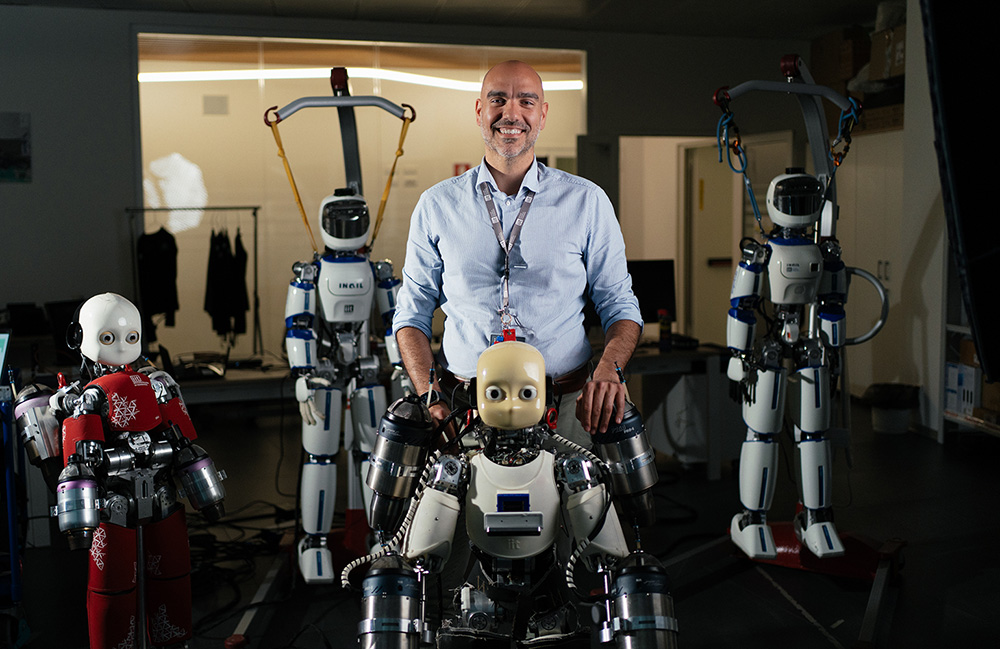
Daniele Pucci, the CEO and co-founder of Generative Bionics. | Source: Generative Bionics
Generative Bionics, an Italian humanoid robot developer, raised €70 million ($81.2 million) in funding. The company said the new funding will help it develop its product, train physical AI systems, and construct its first production plant. Generative Bionics said it is also finalizing its first industrial deployment contracts, which it will announce in early 2026.
The company plans to unveil the complete version of its first humanoid at CES in Las Vegas.
“Our mission is to build a future where intelligent humanoid robots collaborate daily with people, amplifying human cognitive and physical potential,” said Daniele Pucci, CEO and co-founder of Generative Bionics. “Our Physical AI enables us to design and manufacture human-inspired robots that create tangible value across multiple applications. According to leading international analyses, the humanoid robotics market will exceed €200 billion by 2035 and could surpass $5 trillion by 2050. This is an epochal transformation: our goal is to position Generative Bionics as a global leader in Physical AI for human-centric humanoid ecosystems.”
Generative Bionics is building on more than 20 years of research, development, and prototyping of humanoids at IIT. The company spun out of IIT in 2024. IIT has granted the company exclusive licenses to key technologies.
The funding round was led by the Artificial Intelligence Fund of CDP Venture Capital. It included participation from AMD Ventures, Duferco, Eni Next, RoboIT, and Tether.
“With the launch of Generative Bionics, the Italian Institute of Technology is bringing to fruition another key part of its mission to support Italy’s national industrial system, contributing to the field of cutting-edge, next-generation robotics,” said Giorgio Metta, scientific director of IIT. “Twenty years have passed since we launched the iCub project, IIT’s flagship platform, which laid the solid technological foundations for the Institute’s humanoid robotics program—training hundreds of researchers, patenting and transferring to industry a range of advanced technical solutions. Generative Bionics is the culmination of this work: the transfer of science to industry. It shows that sustained, stable support for Italian research leads to concrete, exceptional results. Generative Bionics is the largest academic spin-off in Europe, now entering the global market.”
Generative Bionics’ humanoids are built on technologies developed in IIT’s major robotics programs. This includes iCub, a cognitive research robot; ergoCub, the humanoid co-developed with INAIL to support workers in industrial settings; and iRonCub, a flying humanoid.
From this foundation, the company has defined three technological pillars for its humanoids:
A distributed network of tactile and force sensors, derived from iCub, enabling safe physical interaction
A Physical AI architecture, refined through ergoCub, allowing humanoids to be designed for specific applications and to learn directly from real environments
Advanced AI methods, developed with iRonCub, enabling adaptation to extreme operational conditions such as high temperatures or complex outdoor environments
Humanoids begin joining the workforce
For the last few years, humanoids have dominated conversations in robotics. Every week, new humanoid companies are popping up around the world, and established companies are bringing in large funding rounds.
For example, Agility Robotics today announced its latest Digit deployment. Mercado Libre, a leading commerce and fintech ecosystem in Latin America, is integrating Digit into a facility in San Antonio, Texas. The companies didn’t provide many details about what the robot will do at the facility.
Digit was first deployed with GXO in June 2024. This is widely considered to be the first deployment of a humanoid at a commercial customer site.
While Agility may be leading the way in deployments so far, Figure AI leads in funding. In September 2025, the company closed its Series C funding round. With the round, it surpassed $1 billion in committed capital, bringing its post-money valuation to $39 billion. Figure has deployed its robots with a paying customer since December 2024.
Both Agility and Figure are American companies. In Europe, Generative Bionics will face competition from Humanoid, a U.K.-based developer that released its first humanoid earlier this month. Additionally, Agile Robots, a German developer, unveiled its humanoid Agile ONE in November.