Humanoid robotics developers must address a wide range of applications

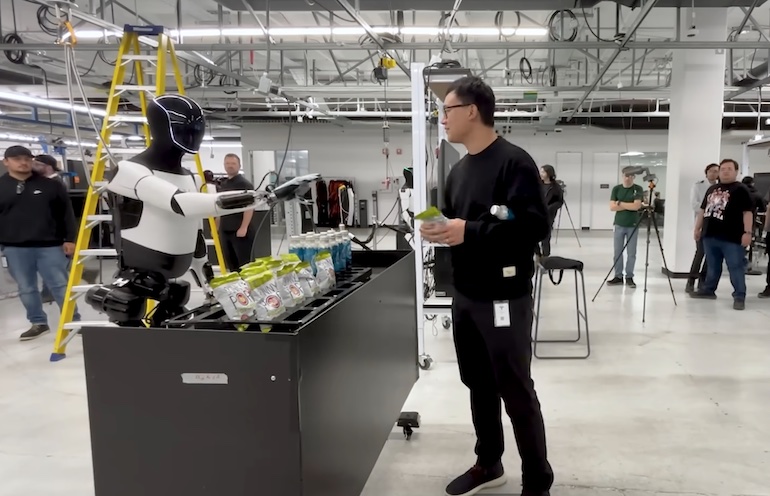
Humanoid robots such as Optimus need to evolve from industrial to more general applications. Source: Tesla
Humanoid robots are becoming an important part of our technological reality, opening up new horizons in science, industry, and everyday life. These machines promise to solve a wide range of problems, thanks to their designed adaptability to the environment.
Sergey Lonshakov, founder of AIRA and the architect of the Robonomics project, recently spoke about the latest advances in humanoid robot development. He addressed the potential benefits and the challenges facing society with these next-generation systems.
When will humanoid robots be capable?
The Chinese-made Unitree G1 is learning to with reinforcement learning, which is very inspiring for me. Since 2015, I’ve been working on technical projects with a team of 15 people — three generations of ITMO University robotics graduates.
Our goal is to develop hypotheses that could be of interest in the near future and try to be the first to implement them. Experiments have included attempts to integrate a user application and technology that would improve or enable interesting IoT scenarios.
The market for humanoids is quite developed in countries where advanced robotics is being developed: Japan, the U.S., China, and Europe. And speaking with roboticists at the level of TED Talks, I can confidently say that the academic world was saying, “This won’t happen.”
Today, robotics has transcended the boundaries of standard consumer perception, which allows us to judge the potential for expanding the range of humanoid robots.
How expensive are these robots?
An industrial manipulator can cost $50,000, with a range from $30,000 to $100,000. Most full-scale humanoids still cost far more. We hypothesized that a robot could be paid for with cash.
We chose 3DR, a popular American drone manufacturer. It had a good GPS navigation board, the Pixk, which is high-quality and remains very popular in DIY robotics. We taught this drone to receive and upload new coordinates for autonomous flight, depending on how much you were paid.
My team demonstrated delivery drone with smart contracts in late 2015 to 2016. We published our research results on the day the Federal Aviation Administration issued its first drone regulations in the U.S. In China, we were one of four teams demonstrating the concept of distributed control of modern drone technologies worldwide.
What were some other robotics experiments?
Let’s return to the economic autonomy of robots. There are various ideas for combating traffic jams in cities. One idea was economic incentives. If you offer people payment to give up their spots, most won’t do it. Well, it’s kind of weird. In a car, every unused second you have is an opportunity to offer someone a spot for a cent.
But cars can exchange cryptographic receipts of offers at a rate of 100 cars per second. You poll, form a trajectory, and overcome it by offering someone a small amount. In this way, you could theoretically charge your Uber in Los Angeles.
In places with crazy traffic, this idea might work. There’s something called Duckietown. It’s an academic project for master’s and graduate students that simulates a city with ducks for self-driving cars.
Another interesting scenario is solar kayak regattas. The competitors had solar panels and no paddles. They raced at a speed of 1 kph (0.6 mph) in Germany.
We were asked to build an autonomous surface vessel (ASV) with solar panels that could handle small waves and navigate a certain route using GPS. We attached a Spanish sensor to it, measuring pH and water temperature. If something was wrong in the water, it would reflected in its pH conductivity; this is surface data scalping.
The marine drone traveled to independent points, taking measurements. In real life, this requires a motorboat, someone with the necessary education, chemical reagents, and the desire to do it every day. The costs are quite high.
We succeeded and were selected for the IUT World Congress in Barcelona at TSBteria. The project is currently being tested at the site of an environmental disaster in Norilsk, Russia.
How economically feasible are fully autonomous humanoids?
Full autonomy isn’t that far off, and the economic justification will be even more advantageous than the physical one. Consider the challenge of finding an assistant to pick up a painting from an agent. While the agent received $3,000 for the sale, a courier must still be dispatched to get the painting, professionally package it for $100, and ship it.
Therefore, if we’re talking about robot autonomy, we must remember that it can exist in multiple dimensions.
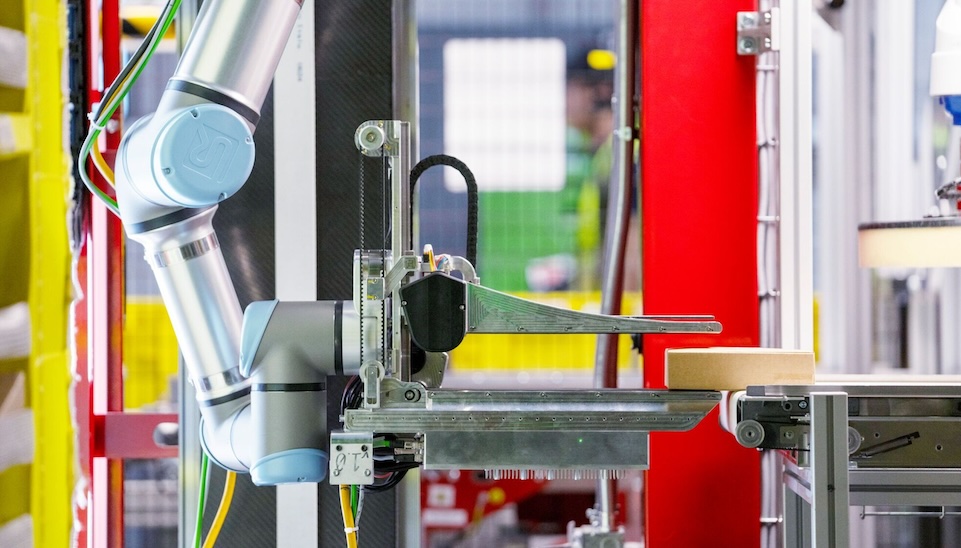
Another experiment: For about a year and a half, a café with a waffle baker operated in St. Petersburg. One barista there made excellent coffee. To avoid distracting the barista with routine work, we installed Universal Robot cobots in the café.
We trained the system to automatically perform the tasks of picking up waffles, opening them, pouring dough, and closing them. The most challenging task was to keep the stick that goes into this food from shaking. This required using the “Apollo-Soyuz” docking system, where a small wooden stick was controlled similarly to a spacecraft docking.
Café patrons enjoyed the sight of a robot baking waffles. This is another example of a use case that’s still somewhat unconventional.
The best place for observing the starry sky is the Atacama Desert in Chile. An avid astronomer bought a semi-professional telescope that can be programmed to retrieve a list of visible objects.
We created a website where you could pay $20 in crypto; the telescope would point to the selected visible object and capture an NFT. You could give someone a picture of the starry sky taken from the best spot for astronomical observations for their birthday.
We want to further develop this project into a 24/7/365 lab. To do this, we need to connect two or three points, because the Otacama Desert rarely sees three days of cloud cover a year. We have Spot quadruped from Boston Dynamics.
You can connect to the lab remotely and learn how to use it for specific tasks. The dog costs $80,000 to purchase, and that’s without the hand it uses to open doors.
Editor’s note: There will be sessions on humanoid robotics, physical AI, and legged systems at the Robotics Summit & Expo. Participating companies will include Boston Dynamics, Agility Robotics, Texas Instruments, and more.

How do humanoid robots reflect their makers?
With all of the attention on humanoid and legged robots, some experts are focusing on business-to-consumer (B2C) applications. The first design observation is that humanoids will have a variety of casings like tracksuits for safety, hygiene, and marketing, even if some manufacturers currently show them without casings to show that they are machines.
Let’s note another feature: Most humanoids today don’t really have “faces.” That’s because their heads are often the location for a lidar sensor or multiple cameras. Some have screens that display intent, but human-machine interaction is often put on a larger screen on the robot’s “chest,” as it was with the former Aldebaran‘s Pepper.
The latest generation of AI could make verbal interaction more natural, but how will humanoid developers handle the demands of onboard compute and secure connectivity? In 2012, no onboard computer that could be attached to a robot was sufficient to perform the calculations needed to determine the robot’s stride to infinity.
Why are grippers expensive?
Now that stable legged locomotion has become table stakes in the past few years, the next challenges include arms that can handle significant payloads with grippers that provide dexterous manipulation.
Robotic fingers require precise and reliable actuators that could be difficult to maintain. Depending on household or industrial use, we don’t know how often they’ll need service. The soft fingertips for tactile sensing will wear out faster.
We’re starting to move from two- and three-fingered grippers to those that more closely resemble human hands. Tactile sensing also offers to help, but power efficiency and cost remain challenges for mobile manipulation.
Unitree’s answer to Spot costs around $80,000. And if you include a manipulator, the full kit will cost $136,000. Many customers opt for fixed sensors, which add about $136,000, and you don’t have to bother with teleoperation.
What are some safety concerns for humanoids?
Boston Dynamics was one of the first companies to show legged robots walking on lawns or up and down hills. But will Rosey the robot be able to silently walk around your home at night with legs that weigh 20 kg (44 lb.)? What about stairs?
When we tried operating a humanoid in a house with wooden floors, our colleague ran off and stuffed it in the car. He said, “I’m afraid it’ll just break my floor.”
Outside of laboratories, smooth movement is a human trait. If a robot makes heart symbols and hands you an egg for an omelet, it’s in alpha testing. Most are closer to simple scenarios, such as serving drinks from behind a counter.
We encountered another pressing challenge when developing robotic skin with adaptive materials to enable cobots. You can program every position of a joint for every split second, but how can the system navigate a previously unknown and dynamic space — with people, pets, and children? Getting a robot to be able to both climb stairs and open doors takes more time and money.
Complex manipulators, a red e-stop button, and safe failure modes all need to be addressed in justifying the expense of consumer humanoids. Safety standards are also starting to emerge, so designers and adopters will need to think about compliance.
How will humanoids come to market?
Robotics companies are aiming for a price range of $20,000 to $50,000, like buying a family car. Elon Musk has stated that this is a goal for Tesla‘s Optimus, which is starting out in automotive manufacturing.
Can a humanoid waiter surpass a human, not only in holding trays, but also in navigating obstacles and providing good service? There have been experiments in California in which a person can order food to be delivered, and the robot operators are in India or elsewhere. But precision and latency are challenges.
There is also the debate of general-purpose automation versus specialization. Most old-school engineers say that all robots should be highly specialized. By contrast, some well-funded humanoid developers are positioning themselves as future providers of general-purpose robots.
Many of the so-called humanoid robots today may have a head, torso, and two arms, but they also have wheels that can’t navigate a stairs or a child’s cluttered playroom. They can already interact with everyday objects, like picking up an egg, selecting a specific vegetable, or unpacking a courier bag, but they do it slowly.
Power Robotics has a mobile manipulator that is not humanoid and costs €10,000 ($11,414).
Three levels of robot help
Let’s define three levels of humanoid function. The first is social — robots that can help the aging, greet store or restaurant patrons, or provide security. Specialized robots exist today for these, and places like Japan are already using them in retail, hospitality, and healthcare.
The next level is what consumers want: a robot to load and unload the dishwasher or take out the trash. Success is defined by being able to push a button and have it get up and do those things.
The first robotic vacuum cleaners mapped the room with a camera pointed at the ceiling, but they knew nothing about obstacles. As navigation and sensing became more sophisticated, both industrial mobile robots and household systems can enter new environments safely.
1X Technologies has developed Neo, a humanoid robot designed to help around the house. However, it is currently using a combination of teleoperation and machine learning.
The third level is if a farmer can have a robot take his place on a tractor and then also have it mow his lawn. A humanoid that can provide that level of economic benefit plus household utility is a longer-term goal.
My team was at Aseda University in 2019 on an experience exchange. It had a robot that had been taught to press pedals and play the organ, synthesizer, and piano. Scientists at Aseda decided to prepare it for a global scientific or trade exhibition so that it could play the piano as a sign of achieving a human-level performance.
That was beyond the scope of mechanics designed in the 1990s. Most of us turned to industrial robots, including drilling machines, tractors, combine harvesters—all the Japanese autonomous equipment that works on the roads is a legacy of this development.
Back then, no one really needed humanoid robots for business. In 2008, Scott Hassan, one of Google’s early investors, sold his 1% stake.
What did Hassan do with the money? He founded Willow Garage, which developed robots to distribute to universities. Thanks to its work on the Robot Operating System (ROS), such robots can play billiards and pour beer today.
Are robots taking jobs?
No, robots have been creating them forever, because no one wants to work in place of a steam engine. When my team visited the Singapore Technological University in 2018, we were asked to operate its autonomous floor mop and develop better algorithms, since it could clean a buidling for 12 hours.
This is exactly what humanoid robotics looks like today. Instead of having to program the movement of each joint and adjust them thorough a feedback loop, today we break a task down into subtasks, feed them into a simulation, and run it 100,000 times to find the successful combinations that will work.
Developers might manage to create an autonomous service comparable to a midlevel butler. It could unload a dishwasher, meet a courier, and put things away in the kitchen. But if this doesn’t happen within two years, investors might move on to other things.
Everyone wants a high-tech lifestyle, so selling a million robots to people who don’t yet know what they need them for — even at $40,000 — doesn’t seen so bit far-fetched.
 About the author
Elena Krosheva is a freelance journalist, marketing analyst, and SEO specialist. She graduated with honors from the Faculty of Journalism at the Institute of Modern Knowledge in Minsk, Belarus, in 2007.
Krosheva covers topics such as digitalization, IT, the modern economy, and transhumanism. She loves computers and cyberpunk, having graduated from a technical college before graduating from the Faculty of Journalism.
The post Humanoid robotics developers must address a wide range of applications appeared first on The Robot Report.