Lucid Bots brings embodied AI to commercial painting

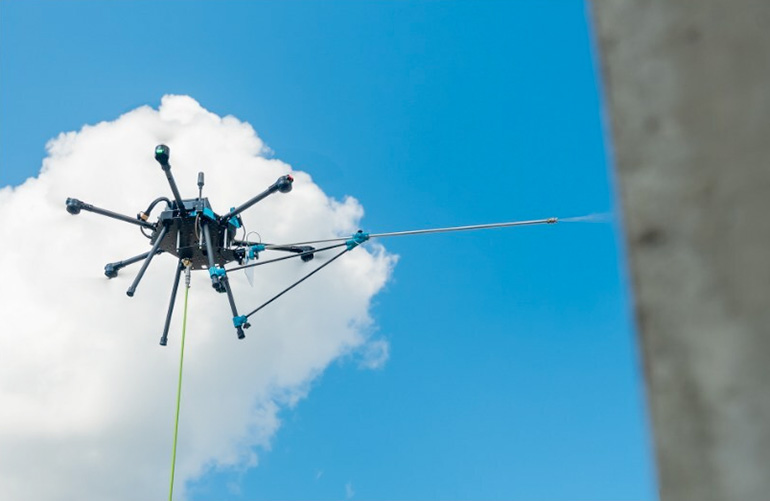
Lucid Bots Inc. today launched painting and coating capabilities for its flagship Sherpa Drone. The aerial drone was originally designed to clean the exteriors of buildings and commercial structures.
“As we execute our growth strategy to enter new market verticals with modular robotics, we’re proving that robotics can redefine how essential work gets done,” said Andrew Ashur, founder and CEO of Lucid Bots. “The pace required to restore and expand our infrastructure demands automation that can do, not just sense and observe.”
“Robots are the arms and legs of AI,” he stated. “Done right, they raise productivity, improve safety, and increase human prosperity. Lucid Bots is at the forefront of this movement, and our launch today will only accelerate our momentum.”
Founded in 2018, Lucid Bots said it is designing AI robotics that can do dangerous and demanding tasks. The Charlotte, N.C.-based company domestically engineers, manufactures, and supports its products, which include the Sherpa drone and the Lavo Bot, a pressure-washing robot.
Lucid is a Y Combinator-backed company, with investments from Cubit Capital, Idea Fund Partners, Danu Ventures, and others. It raised $9 million in Series A funding in May and was recently named a member of the NVIDIA Inception Program.

Automation assists the flight operator
“Demand is off the charts for large-scale commercial and industrial assets where windows and other complex architectural details are uncommon or simply not present — for example, data centers, warehousing, manufacturing, and government buildings,” a Lucid Bots representative told The Robot Report. “The re-industrialization of America needs robots more than ever to keep up with large-scale infrastructure buildout amidst labor challenges.”
The Sherpa lifts a hose from the ground to supply water for cleaning the exterior of a structure. With a power tether, it can remain aloft until the task is complete.
With the new painting and coating system, the drone can paint the exterior features by flying along an automated path for each coat of paint. The paint reservoir remains on the ground.
Lucid Bots has developed automation-assisted features to assist with operations. With the “Distance Lock” feature, onboard sensors keep the Sherpa nozzle at the perfect distance and angle from the surface at all times for consistent coverage.
The operator is simply responsible for moving the drone up/down and left/right with simple joystick controls. With ongoing field operations, Lucid Bots said it expects to rapidly progress towards increased levels of autonomy. Its goal is for one person to be able to deploy several drones working together to complete the task.
To avoid overspray from congealing on the propellors, Lucid Bots said it determined optimal nozzle length and placement to minimize overspray. Most importantly, the distance at which the nozzle is positioned from the surface is critical for the transfer efficiency of paint from the nozzle to the surface.
Distance Lock solves the vast majority of overspray risk, explained the company. Military-grade nano-coatings are also used that prevent paint from adhering to the surface of the drone, allowing for easy cleanup.
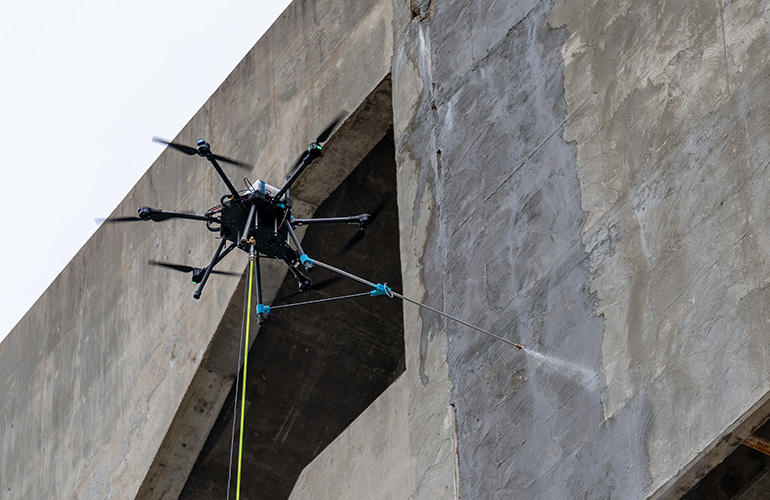
Lucid Bots engineered the spray nozzle with an optimal nozzle length and placement to minimize overspray. Credit: Lucid Bots
Robotics and AI converge for utility
“The launch arrives at a critical inflection point, as the U.S. is experiencing the largest infrastructure buildout in generations, fueling demand for construction workers,” said Lucid Bots. “At the same time, the construction industry is confronting a severe workforce shortage, with over 40% of workers expected to retire by 2031. The work itself is also dangerous, as painting and coating at height carries inherent safety risks that have long made the industry difficult to staff.”
The company said that embodied AI — artificial intelligence that can navigate and manipulate the physical world — enables robots to handle complex, real-world tasks like commercial painting at scale. It claimed that the technology is moving beyond sensing and observation to actually doing work.
“It’s a technological leap that arrives exactly when surging demand meets shrinking labor supply,” Lucid Bots said.
Lucid Bots touts proven platform with new capability
Unlike other systems that require entirely new equipment, Lucid Bots said its module system builds on the proven Sherpa platform, and customers can swap in the new painting module. The Sherpa Drone can reach up to 160 ft. (48.7 m) and cover more than 200 sq. ft. (18.5 sq. m) per minute, operating continuously with a power tether.
The company asserted that a single operator can achieve fast, uniform results using simple, intuitive controls. Compared to traditional methods, projects are completed up to three times faster and at nearly half the cost.
Lucid’s announcement came as it surpassed 500 robots deployed, a major milestone in its growth. The company said its painting capability is now available and has already been deployed in projects such as stadium waterproofing and highway graffiti removal.
The commercial painting and coating industry is valued at $237 billion, and inbound demand for the Sherpa Drone painting module has exceeded expectations, said Lucid Bots.