Neocis unveils upgraded Yomi S robotic system for dental implants

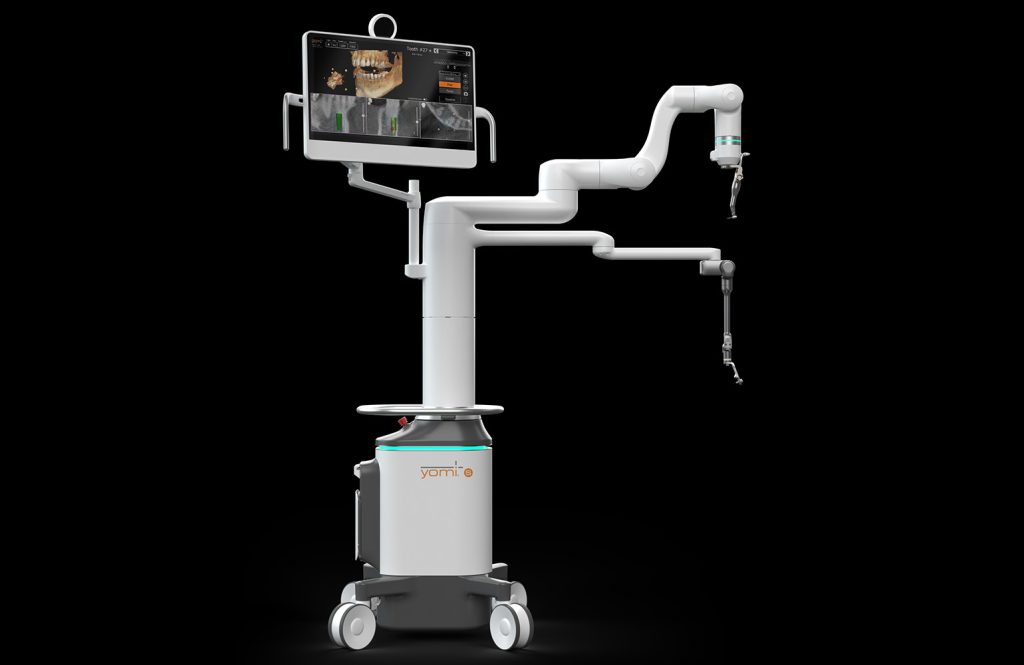
By reducing incisions and surgical time, Yomi S can shorten recovery periods and reduce discomfort, says Neocis. | Source: Neocis
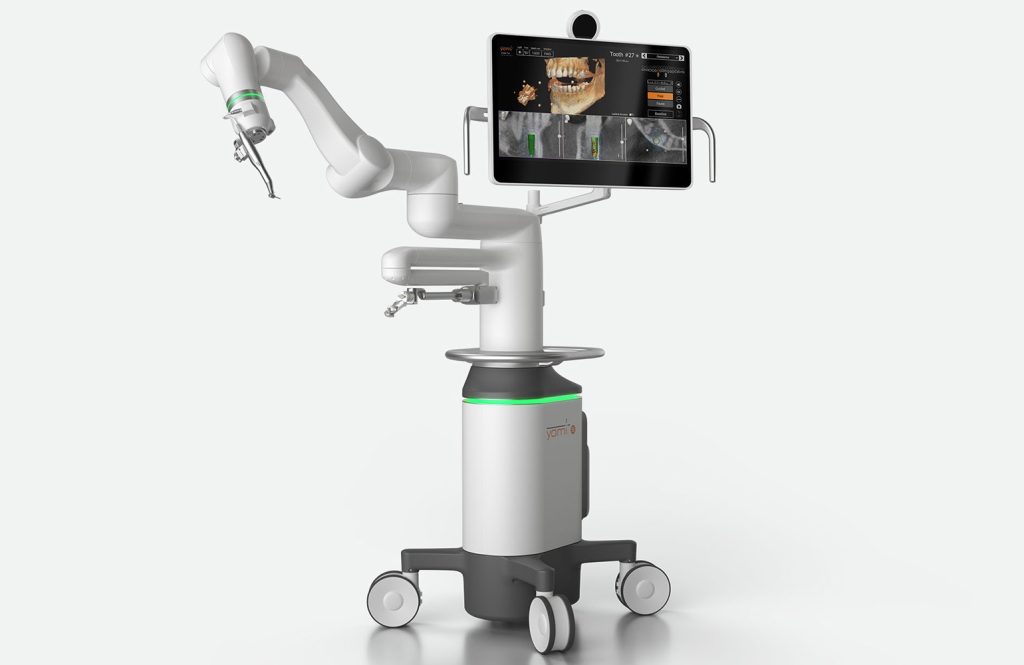
Neocis today unveiled Yomi S, its upgraded robotic system for dental implant surgery. The company said the latest version uses YomiPlan, its AI software, to deliver surgical precision, streamlined workflows, and high-quality patient outcomes.
During an implant procedure, Yomi helps a dentist drill a hole into the bone where a tooth is missing and place an implant in the patient’s mouth. The new Yomi S can be operated by a single practitioner with a foot pedal and touchscreen, said Miami-based Neocis.
The company added that its new system has a smaller footprint, enhanced dexterity, better visibility, and a new AI-powered planning suite that automates complex preoperative tasks.
Neocis said it works closely with leading clinicians to develop technologies that advance patient care and improve quality of life. Its investors include NVIDIA’s NVentures, Intuitive Surgical’s Intuitive Ventures, DFJ Growth, Mithril Capital Management, Norwest Venture Partners, and surgical robotics pioneer Fred Moll.
Alon Mozes, the founder and CEO of Neocis, told The Robot Report more about Yumi’s latest updates, why robotics is so rare in dentistry, and how the company handles the extra challenges that come with its use case.
Dentistry remains a largely untouched market for robotics
Currently, nearly 200 million Americans are missing at least one tooth, and one-third of adults over 65 need full arch replacement. Despite how large this group is, Neocis remains one of the only robotics companies targeting dental care.
“I think there are challenges and opportunities in the dental space,” Mozes said. “It’s a very separate market. You don’t see a lot of the traditional medtech companies like Johnson & Johnson or Stryker participating in dental.”
Typically, dental supply companies are much smaller than medical technology companies. This means they have less extra cash on hand, less interest from investors, and slower research and development timelines.
“The venture capital dollars are usually less in the dental space, which is a shame, because the dental market is huge. In many ways, it’s larger than your typical medical markets,” noted Mozes. “In medicine, usually you’ll sell to a hospital, and there are about 5,000 hospitals in the country. In dentistry, you’ve got 200,000 dentists in the U.S. alone.”
Being first to market, Neocis had to work with the U.S. Food and Drug Administration (FDA) to gain regulatory approval for Yomi. While, on a high level, the system follows similar guidance as surgical robots, there are separate branches within the FDA that review technologies by medical market, Mozes said. Neocis worked with a team that had never seen technology like this.
“When we first applied, back around 2015, we thought it was going to be very straightforward,” recalled Mozes. “Based on our experience with orthopedics, this dental application is a lot lower-risk and less invasive, but it actually took us longer to get clearance because the dental branch hasn’t seen technology like this.”
Dental procedures come with technical challenges
While dental surgeries may seem similar to other procedures a typical surgical robot might handle, Mozes said Yumi handles a different work volume with a much higher level of accuracy. He said orthopedics might be the most similar to dental work, but even then, there are stark differences.
“The level of dexterity, the level of accuracy, and the level of stiffness that you need on a robotic system are very different when you start adapting it to dental,” Mozes said.
“We really needed to customize the solution specifically for head-related procedures, especially inside the mouth,” he explained. “So, we developed our own tracking system. We use mechanical tracking. We’re actually tethered to the patient, as opposed to the camera system that they use in most hospital settings.”
Orthopedic surgeons typically work in large operating rooms, but dental clinicians work in smaller spaces and need a higher degree of accuracy, said Mozes.
“You really need closer to a millimeter or better, whereas in orthopedics, they’re closer to 2 or 3 millimeters, which is a world of difference when you’re talking about the accuracy of a robot,” he said. “On the dexterity, you’ve got to be able to reach inside the mouth at all different kinds of trajectories and angles, and that becomes really challenging.”
Yomi S must adapt to a range of dental workflows
To make things even more challenging, dentists can decide what level of anesthesia to use for dental implants. This means Yomi has to be able to adapt to patients who are awake and asleep during the procedure.
“Even if patients are asleep, it’s actually in some ways harder, because when they’re asleep, they don’t have as much control over their body,” Mozes said. “Sometimes you have patients moving around or bucking, whereas if they’re awake and you tell them to stay still, they’re usually pretty good.”
“There’s a doctor in North Carolina. I was watching one of our earliest cases, and he kept saying, ‘You know, the robot feels like it’s fighting me. It’s not letting me drill where I want to drill.’ I looked closely, and I was like, ‘The robot is moving, but it’s moving because your patient is moving.’ Well, even though they were under anesthesia, they were asleep and snoring, and they kept moving rhythmically,” Mozes said.
“And you look at the drill, and it’s actually moving to keep the doctor on plan with that rhythmic patient motion,” continued Mozes. “He had this ‘a ha moment,’ and it hits him. He’s like, ‘All these years I’ve been drilling trying to stay steady, and I’m drilling ovals because my patient’s moving on me. Really, what I should be doing is moving with the patient to drill that perfect cylindrical hole to fit the implant.’”
YomiPlan helps dentists fully plan procedures
One of the biggest upgrades in the Yomi S is the YomiPlan AI. This AI system is made up of proprietary machine learning algorithms that automate the segmentation of critical anatomy, like nerves and sinuses, from cone beam CT (CBCT) scans, speeding up the planning phase. Neocis used data it gathered from nearly 100,000 implants since 2016 to make this technology possible.
“When you’re placing an implant, it’s crucial to not just drill into the right spot, but also to create an implant that fits well in the patient’s mouth,” said Mozes. “We have software now that’s effectively like Photoshop for teeth. You can really design the crown, that prosthetic, to fit in the space that’s remaining and give you a functional result, so it’s sitting on the implant in a way that will last forever.”
Additionally, the system helps to alert the dentist during procedures to ensure nothing goes wrong.
“When you place the implant into the bone, we know, based on the imaging, how dense the bone is. This is based on the Hounsfield units in the Cone Beam CT scan,” said Mozes. “We can colorize the implant. We can show them, green is good, yellow, you’re in some weaker bone. If you’re red, you might be fenestrating. You might be sticking out just a little bit.”
The new Yomi’s drill is also integrated into the system, giving dentists more information about what’s happening during procedures.
“We can monitor and control the speed and the torque, so we know about the drilling as it’s happening,” Mozes said. “We can control all of that, and the doctor can control it with verbal command.”

Yomi S comes with a longer, customized robot arm
Neocis wanted to make Yomi S more flexible and easier to deploy into a range of dental offices. To do this, it made Yomi’s arm longer, while also giving it a smaller overall footprint.
“These arms are much longer, which allows more flexibility around cart positioning and dexterity in terms of the application,” Mozes said. “So when you have a shorter arm, you’re kind of more limited in how you approach and what trajectories you can reach. With most robotics, you often will hit limits on certain rotations and being able to hit certain poses. We’ve eliminated a lot of that by customizing the design specifically for this dental and generically head-related procedures.”
In addition, Mozes said the Yomi S has a cart that is 30% smaller, making it easier to put in a general dental office with a smaller operating room and fewer support staffers.
“Now they can get a Yomi S, they can fit it in the small operatory, they can position it anywhere around the dental chair, and they can use it as a solo practitioner,” he said. “They don’t necessarily need the extra dental assistant in the room just to help with the robot.”
Yomi gives dentists more visibility and less stress
Because Yomi S gives dentists much more information about how deep they’re drilling, how close they are to essential anatomy, and how to best place the implant, Mozes said it takes a weight off of many dentists’ shoulders.
“They get very nervous. There’s a very tight space. You don’t want to damage healthy teeth,” he said. “If [the implant] is in the back [of the mouth] and they can’t reach, they’re putting a lot of pressure on the patient. And they don’t know if they’re really getting the right location and angle. All of those risks and concerns get mitigated when you get this kind of technology to help them.”
Many dentists are also business owners running their own practice, so Yomi presents an opportunity for them to grow their business, according to Mozes.
“A lot of them will take on additional associates and try and increase their patient flow,” he said. “And this is a great way to take on a fresh out of dental school junior-level associate, but level them up.”