Skild AI raises $1.4B to build ‘omni-bodied’ robot brain

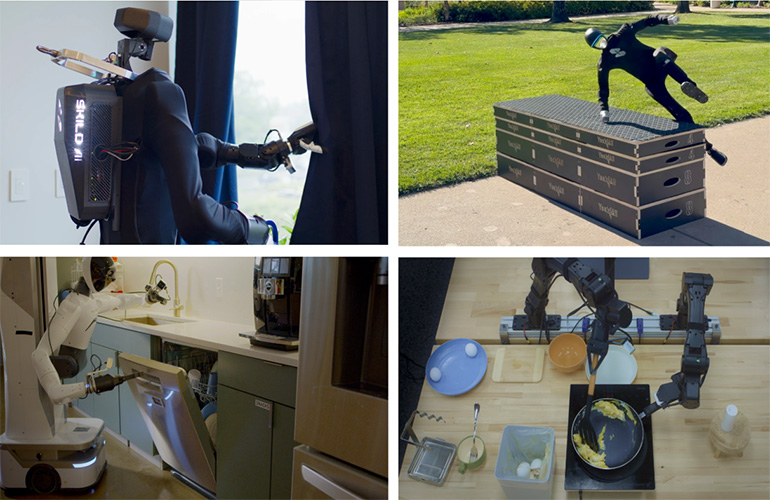
If there is a machine that moves, the Skild Brain will eventually be able to operate it, says Skild AI. Source: Skild AI
To get to a general-purpose robot, developers need a unified robotics foundation model, according to Skild AI. The company yesterday said it has raised close to $1.4 billion, bringing its valuation to more than $14 billion. It is building the Skild Brain, which it claimed is “the industry’s first unified robotics foundation model.”
Unlike traditional AI models that are tailored to specific robot designs, the foundation model is intended to be “omni-bodied” and to control any robot without prior knowledge of its exact body form, including quadrupeds, humanoids, tabletop arms, and mobile manipulators.
The Skild Brain will enable robots to handle everything from simple household chores like cleaning, loading a dishwasher, cooking an egg to physically demanding challenges such as navigating slippery terrain, said the company.
Founded in 2023 by two pioneers in the field of self-supervised and adaptive robotics, Skild AI said its scalable foundation model for robotics “serves as a shared brain across diverse robot embodiments.” It has offices in Pittsburgh, the San Francisco Bay Area, and Bengaluru, India.
Skild Brain trains on alternate data sources
“One of the biggest challenges in building a robotics foundation model is that, unlike language or video models, there is no Internet of robotics,” noted Skild AI. The company said it addresses this challenge by pre-training the Skild Brain on alternate data sources, including learning by watching human videos on the Internet and practicing in physics-based simulations.
In contrast with robots that are designed for specific applications or that are deployed only in isolated or constrained environments, Skild AI said its model can work across different morphologies to vastly expand the available training set.
The Skild Brain can also adapt to unpredictable scenarios, such as loss of limbs, jammed wheels, and increased payload, or even an entirely new body, without retraining or fine-tuning, the company explained.
“The Skild Brain can control robots it has never trained on, adapting in real time to extreme changes in form or environments. The model is forced to adapt rather than memorize – much like intelligence in nature,” stated Deepak Pathak, co-founder and CEO of Skild AI. “We believe that a unified, omni-bodied brain is the fastest way to establish a continuous data flywheel where the model gets better with every single deployment, no matter what the hardware or task.”
In-context learning to scale robot intelligence
Skild AI has shared its progress in a steady cadence over the past year, demonstrating the Skild Brain’s ability to adapt robots’ movements to what they see in the world around them. It credited in-context learning for this generalizability.
When the model is introduced in a new body or unseen environment where its actions may fail, its adjusts the robot’s behavior based on its live in-context experience, the company asserted. Skild AI said it has published this research.
“We believe this omni-bodied learning is essential for building AGI [artificial general intelligence] that works reliably in the physical world, paving the way for robots that can safely help humans in everyday environments,” said Abhinav Gupta, co-founder and president of Skild AI. “This enables robots to operate dynamically in complex environments, without requiring preprogrammed instructions for each scenario.”

Skild AI scales for future deployments
Skild AI said it has grown from zero to about $30 million in revenue in just a few months in 2025. The company is deploying its technology in a variety of environments and scenarios, including security and facility inspection, last-mile and point-to-point delivery, warehouses, manufacturing, data centers, and construction tasks.
SoftBank Group led Skild AI’s latest funding, with participation from NVIDIA venture capital arm NVentures, entities administered by Macquarie Capital, Jeff Bezos through Bezos Expeditions, Disruptive, and 1789 Capital. Lightspeed, Felicis, Coatue, and Sequoia Capital expanded their investments. Skild AI previously raised $300 million in 2024.
“Skild AI is building foundational technology for physical AI across robots, tasks, and environments,” said Dennis Chang, managing partner at SoftBank Investment Advisers. “We’re proud to partner with Deepak, Abhinav, and the Skild AI team to bring that shared vision into real-world applications worldwide.”
In addition, Samsung, LG, Schneider, CommonSpirit, and Salesforce Ventures joined as strategic investors. Other investors included TF Capital, Andra Capital, Palo Alto Growth Capital, KIC, Alpha Square, Mirae Asset, and Destiny.
“Solving intelligence for the physical world unlocks enormous commercial value and long-term strategic national importance,” said Rita Waite, a partner at IQT. “Skild AI is uniquely positioned to do both, and we’re excited to be working with this team as they build.”
Skild AI said it plans to ultimately deploy robotics in consumer homes, with enterprise tasks as the first application. It plans to use the new capital to continue scaling model training and growing deployments of its technology.
“Skild AI is poised to be a critical force behind re-inventing American manufacturing with automation,” the company said.