SoftBank and Yaskawa to collaborate on physical AI for the office

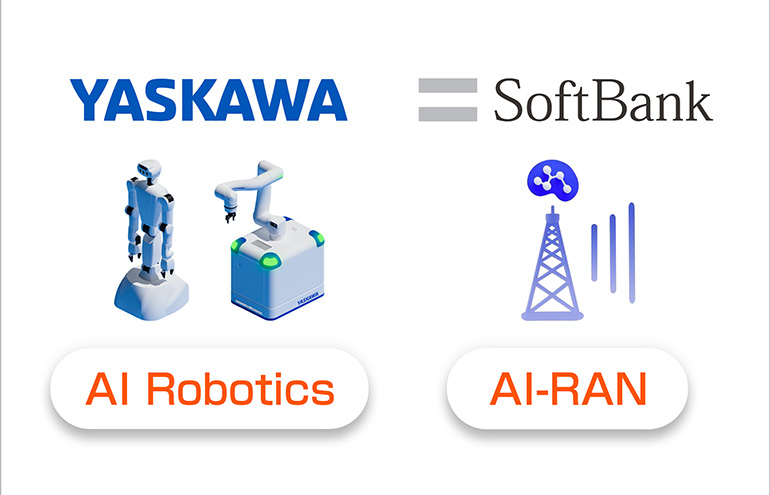
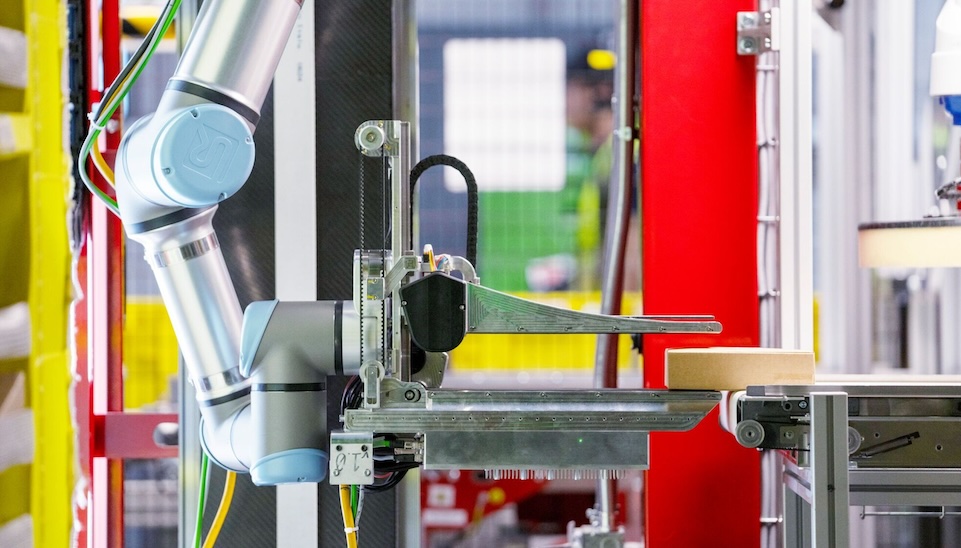
Yaskawa Electric is providing a mobile manipulator, and SoftBank is providing connectivity and AI to develop office robots. Source: SoftBank
SoftBank Corp., which has a history of working with service robots and humanoids, yesterday said it has agreed to collaborate with Yaskawa Electric Corp., a leading provider of industrial automation. The partners said they plan to develop physical AI for social and office robotics.
SoftBank defined physical AI as “technology that enables robots to analyze and interpret data from sensors, cameras, and external systems through AI, allowing them to perform flexible and complex physical movements based on AI-driven decisions.”
“Conventional robots have been designed to perform specific tasks and have not been capable of handling multiple tasks simultaneously,” said SoftBank. Robots using physical AI could perform a wider range of tasks, allowing a single unit to take on multiple roles, the Tokyo-based company added.
Japanese companies address demographic challenges
As Japan‘s workforce shrinks because of an aging population, many industries are turning to automation, noted SoftBank. However, complex environments such as offices, hospitals, schools, and stores require flexible decision-making, it said.
SoftBank and Yaskawa Electric said they plan to address these challenges with homegrown technologies. Kitakyushu, Japan-based Yaskawa said its MOTOMAN NEXT robot arm, released last year, is built on its experience in motion control and its commitment to high safety standards.
SoftBank’s AI-RAN provides a communications infrastructure with AI and radio access networks. By integrating building management systems and using multi-access edge computing (MEC), large volumes of environmental data can be captured by cameras and sensors.
These technologies enable the low-latency analysis of this varied data, said Yaskawa. AI could assess situations and provide robots optimal instructions from an “external perspective,” the companies explained.
Partners to start with physical AI in office buildings
The partners said they have developed an office use case for physical AI robots using their combined technologies. The companies built a virtual building management system for testing and demonstrations. It centrally manages information such as facility data, office-supply inventories, and the operational status of robots.
SoftBank provided AI-RAN and the MEC environment. It also developed a vision-language model (VLM) to generate task instructions by referring to sensor data and other information.
Yaskawa provided the mobile manipulator and the vision-language-action (VLA) model that generates specific robot actions based on instructions from the VLM.
“This use case represents more than just an evolution of industrial robots,” said SoftBank. “By integrating AI and communication technologies into robotics, it envisions a future in which a single robot can take on multiple roles, achieving what can be described as ‘multi-skilled functionality.’”
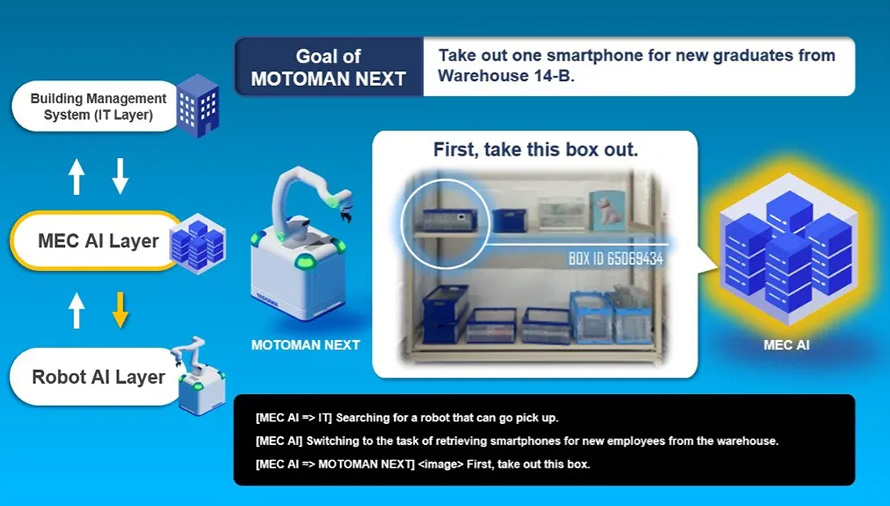
The MOTOMAN NEXT robot will receive instructions based on sensing, AI, and the building management system. Source: SoftBank
SoftBank continues R&D, Yaskawa to show at iREX
SoftBank’s Research Institute of Advanced Technology promotes advanced technologies that support next-generation social infrastructure, including AI-RAN and Beyond 5G/6G, as well as telecommunications, AI, computing, quantum technologies, and technologies in the space and energy sectors. The institute works with universities, research institutions, and partner companies.
SoftBank recently announced its intention to buy ABB Robotics from ABB Group for $5.3 billion.
Yaskawa Electric and SoftBank are demonstrating the new robot at the 2025 International Robot Exhibition (iREX) this week in Tokyo. Yaskawa also plans to show systems for sorting medical instruments, picking and packaging, welding, palletizing, and more.